Start with work, not adjectives
A transferable-skills resume connects a task you have done to a task the new role needs. "Reliable team player" asks the reader to trust you. A clear example lets them see the evidence.
CareerOneStop recommends listing tasks from past jobs and highlighting the action words to identify transferable skills. Its examples include communication, problem-solving, self-management and interpersonal work. Read the skill-identification guidance.
Use that process before rewriting the resume. The goal is translation, not promotion to an imaginary title. Supervising a shift can show coordination. It does not automatically mean you managed a department budget or owned a customer-success portfolio.
Build the evidence bridge
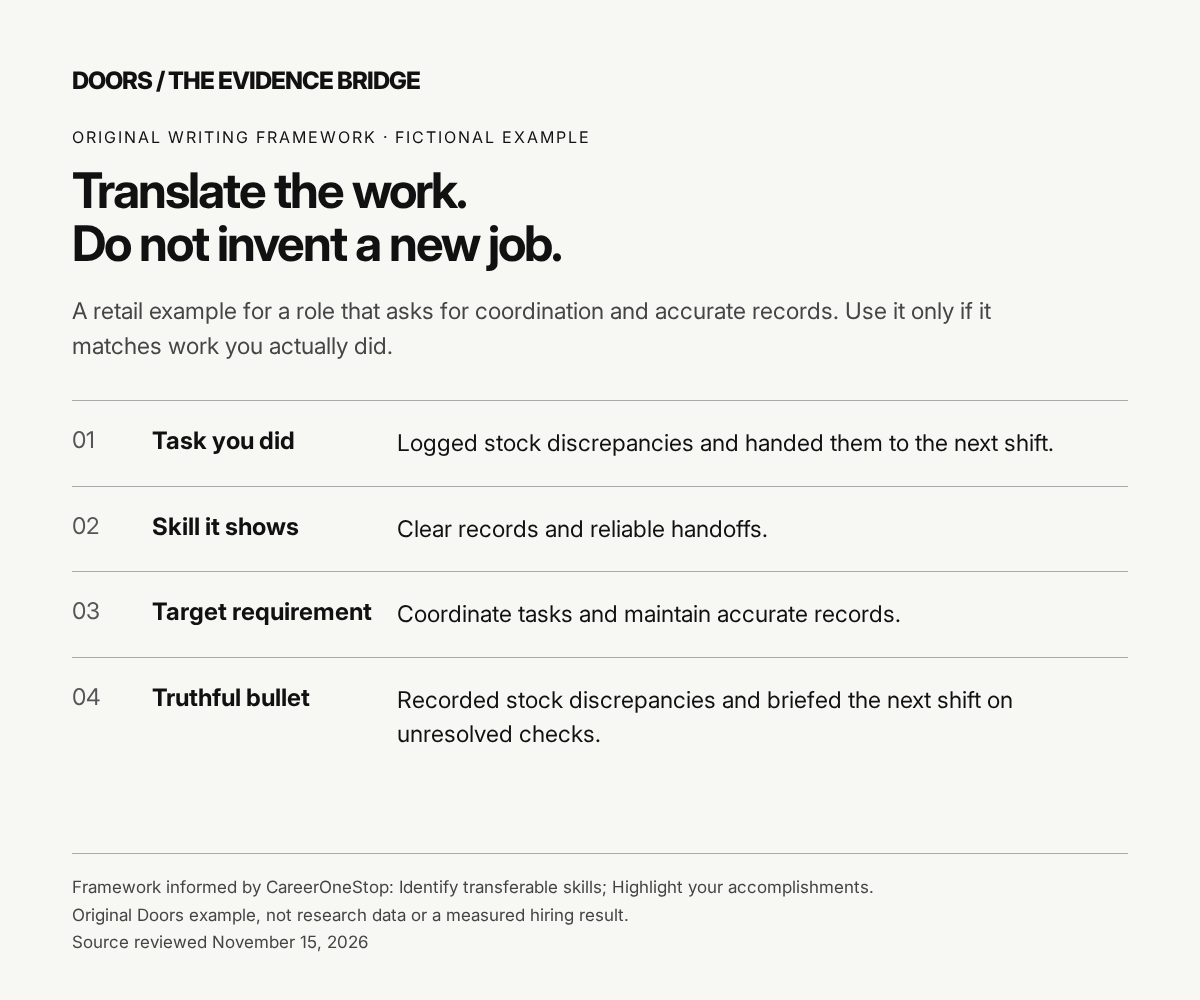
- Write down the task, the situation and what you personally did.
- Name the skill the task demonstrates.
- Find an actual requirement in the target posting.
- Write a short bullet connecting your action to a result you can support.
CareerOneStop's accomplishment guidance uses a challenge, action and result structure. A result can be a concrete improvement without a percentage. See the accomplishment method.
Retail example: make the coordination visible
Original Doors example · fictional
Before: Responsible for stock and customer service.
After: Coordinated stock checks with floor staff and explained out-of-stock options to customers during weekend shifts.
What it shows: handoffs, customer communication and attention to inventory. It may support an operations-coordinator application when those duties are relevant.
What it does not claim: warehouse-system expertise, procurement ownership or a measured reduction in stockouts.
Use the after version only if you did those tasks. If you used a particular inventory tool, name it accurately. If you did not, do not insert the tool from the new posting to get a keyword match.
Hospitality example: explain the handoff
Original Doors example · fictional
Before: Worked front desk and handled problems.
After: Recorded guest issues, coordinated with housekeeping and maintenance, and briefed the next shift on unresolved requests.
What it shows: documenting work, coordinating across teams and following through. These can matter in customer support or administrative work.
What it does not claim: enterprise account management, technical support expertise or a guaranteed resolution time.
A reader should understand what you owned and where you handed off. If you escalated a problem rather than solving it yourself, say that. Good judgment is evidence too.
No honest metric? Keep the detail
Do not invent a percentage because a resume template asks for one. Use a real scope, frequency, work product or observable result. If you trained new staff, explain what you taught and how you supported them. If you know the number and can support it, include it. If you do not, leave it out.
- Useful: "Prepared shift handover notes covering open guest requests and maintenance follow-up."
- Too vague: "Excellent communication skills."
- Unsupported: "Increased operational efficiency by 40%" when nobody measured it.
These are writing examples, not a study comparing callback rates. None is a promise of an interview.
Keep the work history easy to follow
Put relevant skills and examples near the top, then keep the actual employers, job titles and dates clear. Do not hide a work history behind a page of generic competencies. A short summary can name the move you want and the evidence you bring.
Original Doors example · fictional
Retail shift lead moving into operations coordination, with experience in shift handoffs, stock checks and customer issue escalation.
That summary is fictional. Adapt it to the work you have done and the role you are pursuing. Then check the target's required credentials separately. Transferable skills do not replace a required license.
Use the retail transition guide or hospitality transition guide to compare next roles. Use the tailoring guide to choose which evidence belongs in this version.
Find the example you can actually explain
A list of skills can give you words. It cannot tell you which ones you have earned. Start with an ordinary piece of work you remember well, not the most impressive bullet you can imagine.
Your evidence workbench / original Doors exercise
Reconstruct one piece of work
- The situation
- What was waiting, missing, wrong or at risk? Keep customer names and confidential details out.
- Your action
- What did you check, write, explain, change or hand over yourself? Separate your part from the team's.
- Your authority
- What could you decide? What needed a supervisor, a different team or approval?
- The outcome
- What happened that you can support? A completed handoff or corrected record can be useful detail without a percentage.
- The connection
- Which responsibility in the new posting does this help explain? If you cannot name one, save the example for another application.
This expands the CareerOneStop challenge, action and result method into a private writing exercise. You do not need to upload old employer files or customer records to prove you remember your work.
Keep direct, related and missing evidence separate
The same example can be strong evidence for one requirement and weak evidence for another. That is useful to know before you start rewriting it.
Worked example / fictional, not a real candidate
A stock discrepancy is not a purchasing department
- What happened
- A sales associate compared a delivery with the store record, noted a missing item and passed the discrepancy to the supervisor.
- Direct evidence
- Checking a delivery against a record and documenting a discrepancy, if those were the actual tasks.
- Related evidence
- Keeping information accurate and handing an exception to the right person. Explain the retail context rather than hiding it.
- Not demonstrated
- Choosing suppliers, negotiating contracts, managing a purchasing budget or using the next employer's procurement software.
- Usable bullet
- Compared incoming deliveries with store records, documented missing items and escalated discrepancies to the shift supervisor.
The bullet describes the work without inventing a reduction in errors. If you only reported what someone else had checked, change the verb: "Reported delivery discrepancies identified by the receiving team." Less ownership is the accurate answer when it is the true one.
Put the bridge near the top. Keep the history underneath.
CareerOneStop describes a combination resume that pairs a qualifications summary with employment history. You can foreground relevant work without making the reader guess where or when it happened.
Layout specimen / fictional
Relevant evidence, then a clear work record
- Summary: Retail associate with experience checking deliveries, recording discrepancies and coordinating shift handoffs. Interested in order-support work.
- Relevant skills: Name tools you have used and the tasks you can explain. "Inventory records" needs an example; "expert in every inventory system" does not belong here.
- Experience: Keep the actual title, employer and dates. Place the strongest relevant bullet under the role where the work happened.
- Other evidence: Label a volunteer role, course project or practice exercise as exactly that. Do not turn it into employment.
Before keeping a bullet, explain it aloud: what did you do, how did you do it, and where did your responsibility stop? If the answer needs a correction, fix the resume now. Harvard's resume guide favors specific, active, fact-based language. That is a better target than making ordinary work sound like a different job.
Application workbench added . Linked sources were read for these additions. Exercises and worked candidates are original Doors examples, not measured hiring outcomes or current vacancies. The earlier source-review date remains scoped to the original guide.
Sources and context
Sources reviewed November 15, 2026. Templates, fictional examples and decision rules are original Doors editorial work. They are not measured hiring outcomes. Historical data keeps its original period.