Check the route before the pitch
To spot a scam job listing, find the employer independently, follow its own careers link and compare the role with the ad you found. Then check the application destination and the requested action. A familiar logo, polished description or working website is not enough.
Do this before uploading a resume or answering a message. You are checking an opportunity, not proving that every unusual detail is fraud. A vague job can be genuine. A detailed one can be bait.
- Search for the employer by name, rather than using the contact link in the ad.
- Open Careers or Jobs from the employer website. A separate hiring-system domain can be legitimate when the employer links to it.
- Compare the job number, team, work location and duties. A matching title alone does not establish the same opening.
- If the route does not match, stop and use contact details you found independently to ask about it.
The FBI recommends avoiding links, downloads and attachments in unsolicited job offers while you establish their source. Read the FBI warning.
Money to unlock work is a stop sign
The FTC describes task scams that display supposed earnings, sometimes after paying a small amount to build trust. Then the platform asks you to deposit money to finish tasks or withdraw your balance. The balance is part of the scam, not proof that you have been paid.
- Do not deposit cryptocurrency to unlock work or earnings.
- Do not send money to an alleged employer because the dashboard says you owe a balance.
- Do not let a group chat full of supposed success stories replace independent verification.
- Do not pay a second unsolicited contact who promises to recover lost cryptocurrency.
FTC task-scam research and FBI protection guidance describe these patterns. This does not make ordinary remote work suspicious. It makes a pay-to-get-paid request a reason to stop.
Follow the request, not the dashboard
A useful scam check follows the next action. What must you click, share or pay before the supposed work can continue? The FBI's June 2024 warning describes fake work platforms that demand cryptocurrency while showing earnings the victim cannot cash out. The FTC's December 2024 research explains how small initial payouts can build trust before the deposit demand. A payment at the beginning does not settle what comes next.
Original Doors reading map / not a report about a particular employer
From an offer to a demand
- The approach
An unexpected message offers easy online work. Before opening a file or following its application link, find the organization independently.
- The display
A platform shows commissions or an account balance. Do not treat a number on that interface as money you can withdraw.
- The condition
You must deposit money to finish a set of tasks or release your earnings. Stop at the requested payment. A countdown, bonus or supposed success story does not change the action.
- The next contact
Someone offers to recover lost cryptocurrency for a fee. The FBI warns against paying those recovery offers too. Use official reporting routes instead.
The sequence is a teaching aid, not a checklist that every scam must follow. Sources: FTC December 2024 Spotlight, pages 1-2; FBI June 4, 2024 alert. Re-read for this addition November 16, 2026.
An interview, a contract and a secure-looking site can all be part of the pitch
The FBI's January 2020 warning describes criminals conducting interviews, sending employment contracts and requesting identity or banking details through spoofed company websites. It also warns that criminals can use HTTPS. So "I interviewed," "I signed an offer" and "there is a padlock" are not substitutes for an independently verified employer and route.
What the document says
"You have the job"
That is a claim from the sender. Before supplying identity documents or payroll details, verify who issued it through a route you found independently.
What the request does
Moves money or identity data
Write down the requested action separately from the job title. An attractive role does not make a payment demand or unverified upload safer.
Source: FBI, Cyber Criminals Use Fake Job Listings To Target Applicants' Personally Identifiable Information, January 21, 2020, Methods and Tips to Protect Yourself. Re-read November 16, 2026. The document-versus-action comparison is our teaching tool, not an assessment of a particular offer.
What the research actually counted
The FTC Spotlight's task-scam estimates came from hand-coding a random sample of 500 job-scam reports for each year studied, excluding reports without a narrative, then applying the identified share to that year's report total. Its historical loss figures use the broader job-scams and employment-agencies report category. Neither method samples every job advertisement online.
That is why the loss chart below is not a probability that the next ad you see is fraudulent. Use it to understand reported harm. Use the source route and requested action to decide what to do with an individual message. Read the method in footnotes 1-2, page 3.
Reported harm, not a fake-job percentage
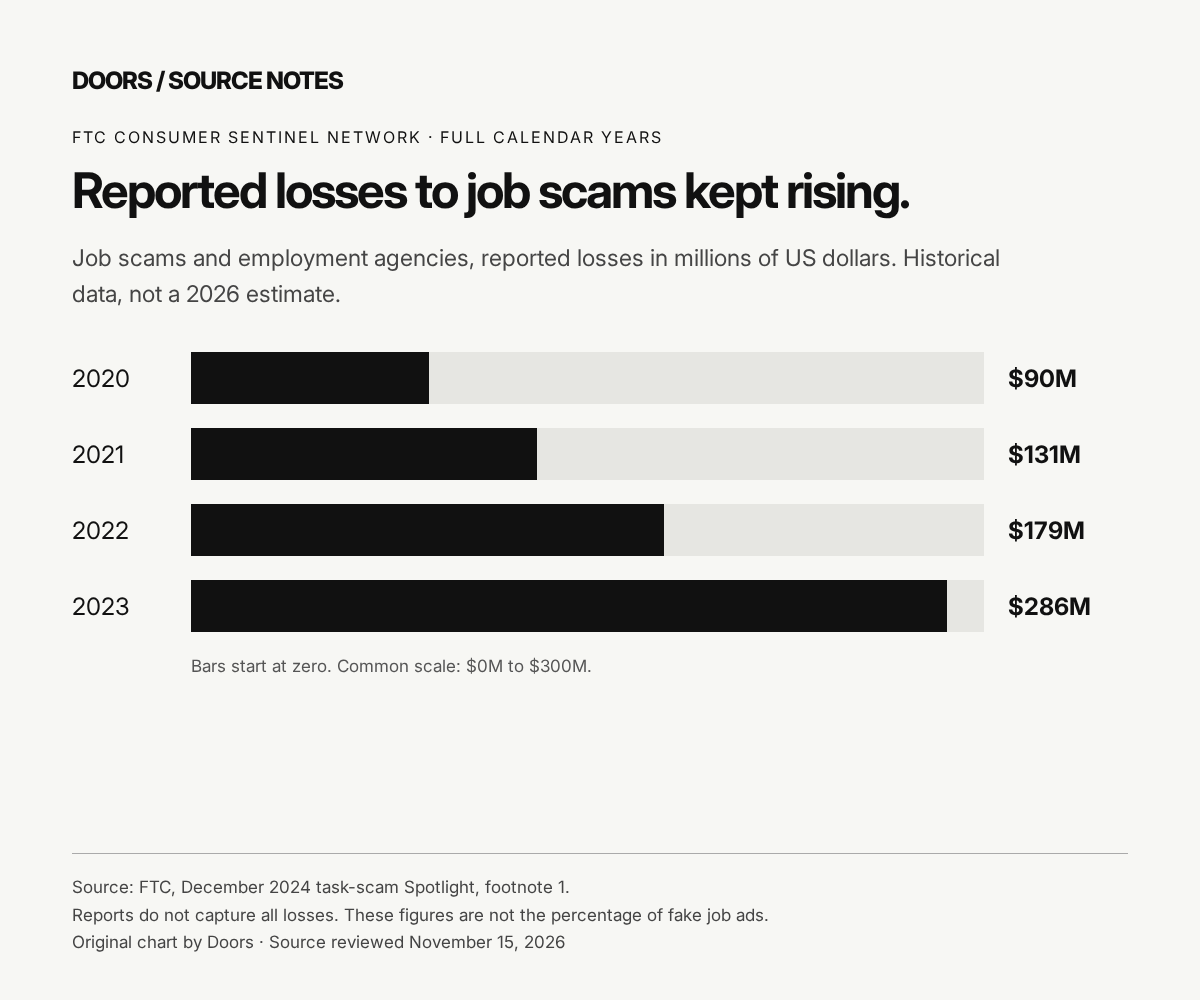
The chart in text: 2020: $90 million; 2021: $131 million; 2022: $179 million; 2023: $286 million.
The FTC recorded $286 million in reported losses in 2023 for the job-scams and employment-agencies category. These are reports to its Consumer Sentinel Network. They do not count every loss, and they do not tell you what share of job ads are fraudulent. Source and method.
A quick comparison: unclear, stale or a scam request?
Original Doors example · fictional
Unclear: an ad says remote but names only one state. Ask where the employee must live. That restriction alone does not make the role a scam.
Unconfirmed: the job appears on an aggregator but not in the employer search. It may have closed, moved or been copied. Do not call it fake without evidence.
Stop: a contact tells you to deposit $80 in cryptocurrency to unlock your first shift. Do not pay. The requested action matches the task-payment pattern described by the FBI.
These examples are written by Doors, not reports about actual companies. Keep factual notes and save the ad URL. Avoid public accusations based only on uncertainty.
What to share, and when to pause
A resume and an onboarding form are different things. Before sending identity documents, financial details or other sensitive information, establish who is collecting them and why. Do not give an unverified sender sensitive information because their message calls it a required hiring step.
You do not need to download an attachment to investigate it. Use the independent employer route instead. If you have already sent money or personal information, our recruitment-scam guide separates reporting and recovery steps from ordinary job-search questions.
Report suspicious work-from-home offers through the FBI Internet Crime Complaint Center guidance. Keep transaction records if money moved. Do not send us identity documents or financial account details.
Keep the opportunity, not the pressure
If the employer route matches, the role matches and the process makes sense, continue with the application you intended. If a key detail stays unresolved, record it as unknown and move on to another lead. You do not owe a stranger your money or an evening of detective work.
Doors does the looking for you. These checks are here to protect your time whether you use Doors or not. A source link is useful evidence, not a guarantee that a sender is genuine or an employer will hire.
Sources and context
Sources reviewed November 15, 2026. Templates, fictional examples and decision rules are original Doors editorial work. They are not measured hiring outcomes. Historical data keeps its original period.